From Havana's Hearth to America's Finest Tables: The Creole Culinary Revolution Taking Over Private Kitchens
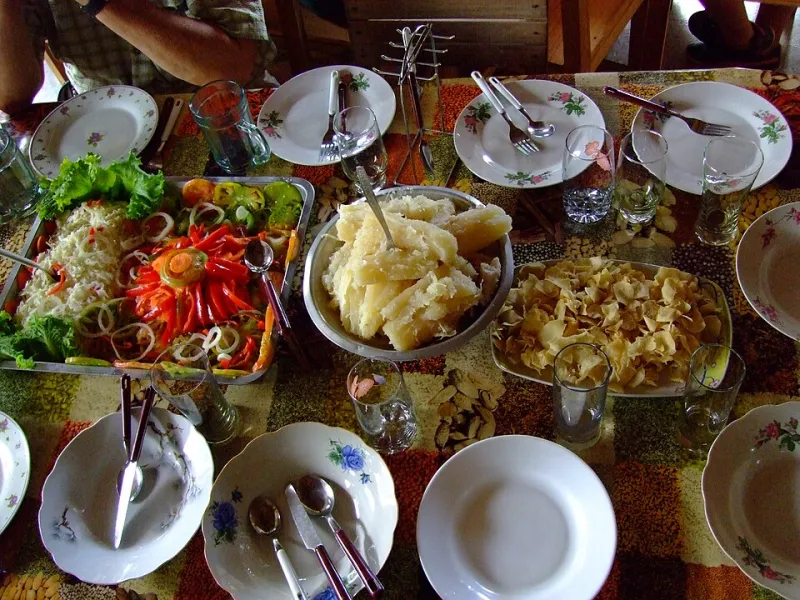
Photo: Arnoud Joris Maaswinkel, CC BY-SA 4.0, via Wikimedia Commons
There is a particular moment that many of our guests describe with striking consistency. It arrives not in the grand dining room, not during a sunset cocktail on the terrace, but in the quieter, more intimate setting of a Havana kitchen — where the scent of sofrito blooming in rendered fat meets the faint salt of the Caribbean air drifting through an open window. It is, by every account, transformative. And increasingly, it is a transformation that America's most discerning travelers are refusing to leave behind when they depart.
Across the United States, a sophisticated culinary movement is gaining momentum in the private homes of those who have made Havana a destination of genuine cultural engagement rather than mere tourism. Cuban Creole cuisine — a centuries-old synthesis of Spanish, African, and indigenous Taíno culinary traditions — is finding its way into the kitchens of Manhattan penthouses, Malibu estates, and Miami waterfront residences. The catalyst, more often than not, is a stay in Havana itself.
The Architecture of Cuban Creole Cooking
To understand why this cuisine commands such reverence among serious culinary travelers, one must first appreciate its structural elegance. Cuban Creole cooking — known locally as cocina criolla — is not defined by complexity of technique so much as by the depth of its foundational elements. The sofrito, a slow-rendered base of onion, garlic, green pepper, tomato, and cumin, functions as the backbone of countless preparations, from ropa vieja — the famous braised shredded beef — to picadillo, a refined spiced ground meat preparation that speaks equally to Spanish and Moorish culinary heritage.
What distinguishes authentic cocina criolla from its diaspora interpretations is, above all, patience. Havana's finest cooks — many of whom operate out of paladares, the celebrated private restaurants that have become the city's most coveted dining addresses — speak of time as an ingredient in its own right. Beans are never rushed. Marinades are measured in days, not hours. The result is a cuisine of extraordinary depth that rewards attentiveness.
This philosophy resonates profoundly with the American culinary elite, who have grown weary of novelty for its own sake and are increasingly drawn to traditions that carry genuine historical weight.
What Guests Discover in Our Kitchen
At Hotel Quinta Avenida Habana, we have long recognized that the most meaningful travel experiences are those that engage all of the senses — and that the kitchen is among the most revealing rooms in any culture. For this reason, we offer select guests the opportunity to participate in curated culinary sessions with members of our kitchen team, whose combined knowledge of Havana's food traditions spans generations.
These are not cooking classes in the conventional sense. They are, more precisely, conversations conducted through food. Our chefs speak of the African influence on Cuban seasoning — the use of bijol, a native annatto-based coloring agent that imparts both hue and a subtle earthiness to rice dishes — with the same authority and affection that a sommelier might bring to a discussion of terroir. Guests learn to identify the specific variety of plantain suited to tostones versus maduros, and to understand why the distinction matters enormously to anyone serious about the craft.
Several of our guests have returned home and replicated these sessions in their own kitchens with remarkable fidelity, working with private chefs and specialty importers to source authentic Cuban ingredients — or the closest domestically available equivalents.
Celebrity Chefs and the Havana Pilgrimage
The influence of Cuban culinary tradition on America's professional cooking class is not a new phenomenon, but it has accelerated considerably as travel to Cuba has become more accessible to American citizens. A number of prominent chefs based in New York, Los Angeles, and Miami have made deliberate pilgrimages to Havana in recent years, seeking not inspiration in the abstract but specific technical knowledge they cannot acquire elsewhere.
What they find consistently surprises them. The sophistication of Havana's private dining scene — its paladares operating out of restored colonial mansions and mid-century modernist interiors — belies any expectation of austerity. Chefs speak of encountering preparations of extraordinary refinement: whole-roasted lechón basted with citrus and garlic mojo over the course of an entire day; ajiaco, the deeply layered root vegetable stew that is considered by many Cuban culinary historians to be the nation's most emblematic dish; and desserts built around guayaba and queso blanco that manage to be simultaneously rustic and precise.
For those who have made Quinta Avenida their Havana address, our concierge team has cultivated relationships with several of the city's most respected culinary figures, facilitating introductions that would be otherwise inaccessible to visiting guests.
Translating Havana to the American Private Kitchen
The process of adapting cocina criolla to an American private kitchen is, admittedly, one that requires both creativity and commitment. Certain ingredients — fresh ají cachucha peppers, yuca of the precise variety grown in Cuba's Pinar del Río province — require sourcing from specialty suppliers, many of whom operate through Miami's established Cuban-American wholesale networks. Others, such as boniato (a white-fleshed sweet potato with a drier, nuttier character than its orange American counterpart), are increasingly available through premium grocery channels catering to the metropolitan market.
Private chefs who have undergone the Havana experience speak of the cuisine's remarkable adaptability. The principles of cocina criolla — the primacy of the sofrito, the transformative power of mojo marinades built on sour orange and garlic, the balance of richness and acidity — translate fluidly to a well-appointed American kitchen, provided the cook is willing to respect the tradition's inherent rhythms.
Several of our most dedicated culinary guests have gone further still, commissioning custom spice blends and importing preserved guayaba paste and ron añejo — aged Cuban rum — for use in both savory glazes and dessert preparations. The results, by their own accounts, have become the centerpieces of private dinner parties that generate conversation long after the table is cleared.
A Gateway, Not a Destination
At Hotel Quinta Avenida Habana, we understand that a truly exceptional stay does not conclude at departure. The finest luxury travel plants something lasting in the traveler — a new lens through which familiar pleasures are seen differently, and through which new ones become possible. Cuban Creole cuisine, in its honesty, its depth, and its quiet insistence on the value of time and tradition, is precisely the kind of discovery that endures.
We invite our guests to approach Havana's culinary heritage with the same seriousness they might bring to a great wine region or an important art collection. The rewards are considerable — and they are, unlike so many things in the world of luxury travel, entirely portable.