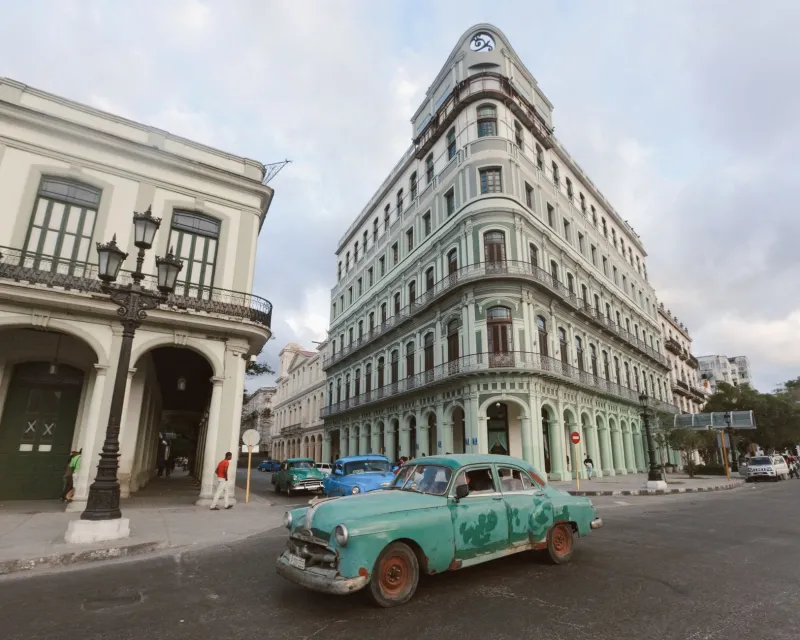
Architecture of Stillness: Why Havana's Colonial Walls Offer the Rarest Luxury of All — Quiet
There is a particular quality of silence that greets a guest upon crossing the threshold of Hotel Quinta Avenida Habana for the first time. It is not the manufactured hush of a heavily insulated modern tower, where sound is suppressed through layers of engineered material and double-glazed glass. It is something far older, far less deliberate, and — paradoxically — far more effective. It is the silence that centuries of colonial construction have quietly perfected, and it is, for the discerning traveler arriving from the perpetual noise of American urban life, nothing short of extraordinary.
We live, most of us, inside a continuous roar. Open-plan offices, airport terminals, urban apartments with walls thin enough to conduct a neighbor's telephone conversation — modern life has made acoustic privacy a genuine luxury. Noise-canceling headphones have become a ubiquitous accessory, not because people wish to listen to music constantly, but because they desperately wish to hear nothing at all. Against this backdrop, Havana's colonial architecture does not merely offer a pleasant aesthetic. It offers a fundamentally different relationship with sound.
What Coral Stone Does That Concrete Cannot
The material from which Havana was built is not incidental to its acoustic character. Much of the city's historic fabric — including the structures along the elegant corridor of Quinta Avenida — was constructed using coral limestone quarried from the island's own geology. This material, dense and irregular in its cellular structure, does not merely block sound in the manner of poured concrete. It absorbs it, dissipates it, transforms it into something closer to resonance than noise.
Acousticians who study historic buildings have long recognized that the irregular surfaces of aged stone create what is sometimes described as diffuse reflection — a scattering of sound waves that prevents the sharp, fatiguing echoes common in modern interiors. Walk through a glass-and-steel hotel lobby and you will hear every conversation, every rolling suitcase wheel, every sharp footfall amplified and returned to you. Walk through a well-preserved colonial structure and those same sounds soften, blur at their edges, and dissolve before they reach you with any force.
The walls at Hotel Quinta Avenida Habana are, in this sense, not merely decorative. They are functional instruments of calm.
The Ceiling as Acoustic Partner
Equally significant is the vertical dimension of Havana's colonial interiors. The high ceilings characteristic of this architectural tradition — often reaching four meters or more in the principal rooms — were originally conceived as a practical response to the Caribbean climate, allowing hot air to rise and encouraging the circulation of cooler air at the level where people actually inhabit a space. The thermal logic was sound. But the acoustic consequence was, if anything, even more valuable.
High ceilings create what acoustic designers call a large volume-to-occupant ratio, meaning that the sound energy produced by any given number of people is distributed across a far greater cubic volume of air. The result is a natural reduction in what is technically termed the reverberant field — the ambient noise level that persists in a room after its immediate source has ceased. In practical terms, a conversation held at one end of a high-ceilinged colonial room does not pursue you to the other end. Sound, here, has space enough to become itself and then gracefully expire.
For guests accustomed to the compressed acoustic environments of contemporary hotels — where every sound bounces efficiently between hard floors, low ceilings, and glass partitions — this vertical generosity comes as a genuine physical relief.
The Courtyard as Sound Sanctuary
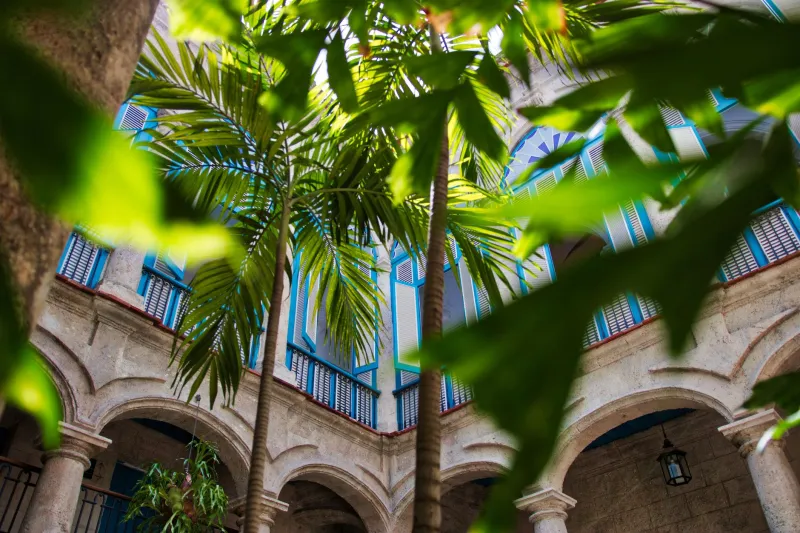
Perhaps the most sophisticated acoustic feature of Havana's colonial architecture is one that receives the least attention: the interior courtyard. This design element, inherited from Spanish colonial tradition and adapted with particular elegance in Cuba's finest residential and civic buildings, creates what amounts to a private acoustic chamber at the heart of a property.
The courtyard functions as a transition zone between the sounds of the street and the silence of the interior. Noise from outside — traffic, vendors, the distant percussion of a neighborhood ensemble — enters the courtyard, where it encounters the dampening effect of planted vegetation, the absorption of porous stone paving, and the complex geometry of surrounding walls that scatter rather than reflect sound energy. By the time that ambient noise reaches the rooms that open onto the courtyard, it has been transformed from intrusion into atmosphere: a gentle, indistinct murmur that registers as presence rather than disturbance.
This is, in acoustic terms, a sophisticated filtering system. And it costs nothing, requires no maintenance, and improves with age.
Restoration Without a Treatment Menu
The wellness industry has, in recent years, invested heavily in the concept of acoustic therapy — the deliberate use of sound environments to reduce cortisol levels, lower heart rate, and facilitate the kind of mental restoration that modern life perpetually defers. Sound baths, white noise machines, binaural audio programs, and anechoic chamber experiences have all been marketed, at considerable expense, to travelers seeking genuine rest.
Havana's colonial architecture achieves many of the same outcomes through entirely passive means. Guests at Hotel Quinta Avenida Habana who arrive carrying the accumulated sonic debt of months of urban professional life — the open-plan office, the delayed flight, the conference call conducted from a glass-walled meeting room — frequently report a quality of sleep within the first night that eludes them at home despite every technological aid at their disposal.
This is not coincidence. It is physics, expressed through architecture, refined over centuries.
For executives seeking a strategic retreat that delivers genuine cognitive restoration rather than a change of scenery, for creative professionals whose work depends on access to a quality of interior quiet that modern cities have largely eliminated, and for any traveler who has begun to suspect that what they most require is not stimulation but its opposite — Hotel Quinta Avenida Habana offers something that cannot be replicated in a newer building, in a louder city, or at any price point that simply throws money at the problem.
The Sound of Havana, Properly Heard
None of this is to suggest that Havana is a silent city. It is emphatically, gloriously not. The music that animates its streets and plazas, the human vitality of its neighborhoods, the particular acoustic signature of a Caribbean capital that has preserved its density and its street life with unusual fidelity — these are among the city's most celebrated qualities, and they are audible, richly and abundantly, whenever a guest steps beyond the hotel's threshold.
But the experience of that external vitality is transformed by the contrast that awaits upon return. When the city's music is something you can enter and exit — when genuine silence is available on demand, within walls that have been quietly perfecting the craft of stillness for three centuries — Havana's sound becomes not an assault but a gift. You hear it differently when you know that the quiet is always there, waiting, on the other side of a coral stone wall.
That alternation — between full immersion in one of the world's most sonically alive cities and retreat into one of its most acoustically refined interiors — may be the most underappreciated luxury that Quinta Avenida has to offer. And it requires no booking, no reservation, and no additional charge. It is simply what the building is.