The Disciplined Art of Doing Nothing: A Framework for Genuine Freedom in Havana
The founders, executives, and creative directors who stay at Hotel Quinta Avenida Habana share a particular affliction. They are extraordinarily good at structure. They have built careers — and in many cases, companies — on the ability to convert ambiguity into action, to impose productive order on resistant circumstances. They arrive in Havana with the same operating system that made them successful, and within forty-eight hours, most of them realize it needs a temporary reboot.
Havana is not a city that responds well to optimization. It was not designed for efficiency. Its rhythms are older and more patient than the quarterly calendar, and the travelers who attempt to process it through a conventional itinerary tend to leave having seen a great deal while experiencing very little.
The art of the unplanned day in Havana is not the absence of intention. It is the practice of holding intention loosely enough that the city can redirect it.
Why Control-Oriented Minds Struggle Here
Consider the typical approach a high-achieving American brings to leisure travel. Research is conducted. Restaurants are reserved weeks in advance. Museum hours are confirmed. A rough schedule exists for each day, with built-in flexibility that is, in practice, rarely used. This approach works reasonably well in cities that operate on legible, predictable systems.
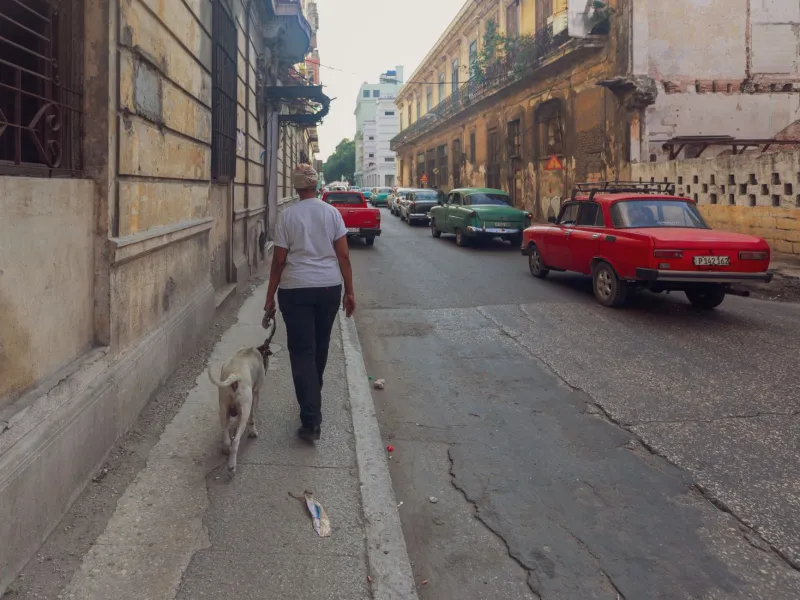
Havana does not operate on legible, predictable systems. The restaurant that was open yesterday may be closed today for reasons that will never be fully explained. The neighborhood that was quiet on Monday has transformed itself by Thursday into the site of an impromptu concert that will last until well past midnight. The conversation you did not expect to have — with the retired architect sitting outside his building on Calle 16, or the musician tuning an instrument on a Vedado staircase — will turn out to be the most significant thing that happened to you all week.
None of this can be scheduled. And for the professional mind trained to treat unscheduled time as waste, that fact produces a specific kind of anxiety that is worth examining directly.
Redefining Productivity
The anxiety dissolves when the definition of productivity is expanded.
High-achieving travelers are not, in fact, opposed to unstructured time. They are opposed to purposeless time. The distinction is crucial. An unplanned afternoon that produces a genuine human connection, an unexpected insight, a sensory experience that reorganizes something in the mind — that afternoon is not unproductive. It is producing the kind of material that structured schedules cannot generate.
The most useful reframe for a Quinta Avenida guest approaching an open day is this: Havana is conducting the meeting. Your job is to show up prepared to listen.
This is not passivity. Listening well is an active discipline. It requires the suppression of the internal monologue that is always planning the next move, and the cultivation of genuine receptivity to what is actually present. For many accomplished professionals, this is genuinely harder than running a board meeting — and correspondingly more rewarding when it is done well.
A Practical Architecture for Spontaneity
For those who find pure formlessness genuinely uncomfortable, there is a middle path — and Hotel Quinta Avenida Habana's staff are practiced in helping guests find it.
Anchor, don't schedule. Rather than building an itinerary of sequential activities, identify one or two fixed points in the day — a late breakfast on the terrace, an evening meal at a specific hour — and leave everything between them open. The anchors provide psychological security without constraining the day's actual content. What happens between breakfast and dinner is entirely determined by what Havana presents.
Walk with direction, not destination. Choose a general bearing — toward the Malecón, toward Vedado, toward the older streets of Miramar — and begin walking. Carry nothing that will make you a tourist rather than a traveler. The distinction is visible and it matters: residents respond differently to someone who is clearly moving through the city with curiosity and openness than to someone who is visibly checking a phone map every three minutes.
Cultivate the pause. The single most productive thing a Quinta Avenida guest can do on an open day is to sit somewhere — a plaza, a café, a shaded bench on the boulevard — and simply observe for twenty or thirty minutes without agenda. What you notice in that time will be more useful to your understanding of Havana than any guided tour. The city reveals itself to those who are patient enough to wait for it.
Follow the conversation. When a genuine exchange begins — and in Havana, genuine exchanges begin constantly, with a directness and warmth that can surprise American visitors accustomed to urban anonymity — follow it. Cancel whatever was notionally next. The conversation is what is next. This is not inefficiency; it is the entire point.
What the Unplanned Day Actually Produces
Guests who have surrendered a day or two to Havana's own logic consistently report the same phenomenon: the experience that mattered most was the one they could not have anticipated. The afternoon that began as a walk and became something else entirely. The encounter that produced a perspective they have continued thinking about months after returning home.
This is not coincidence. It is the natural result of placing a trained, curious, accomplished mind in an environment that cannot be pre-processed. When the usual shortcuts are unavailable — when the Yelp reviews and the TripAdvisor rankings and the curated guides all fall short of describing what is actually in front of you — the mind is forced to engage directly. And direct engagement, for minds of genuine quality, tends to produce results.
The Return to Structure
There is a particular pleasure in returning to Hotel Quinta Avenida Habana after an unplanned day in the city. The room, the quiet, the considered elegance of the property — these things are experienced differently after hours of genuine immersion. The comfort is earned rather than assumed, and earned comfort has a quality that its unearned equivalent simply cannot match.
The most productive professionals in any field understand that recovery is not the opposite of performance — it is its prerequisite. The open day in Havana, properly inhabited, is not a vacation from capability. It is the condition under which capability deepens.
Bring your ambition to Havana. Then, for one deliberate day, set it down. What you pick up in its place may prove considerably more valuable.