Why the Boulevard You Sleep On Determines the Havana You Experience
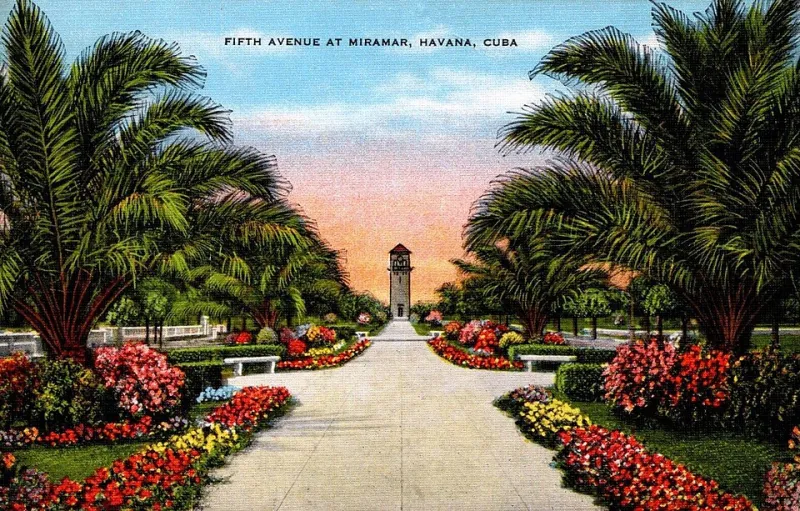
Photo: Roberts & Co., Havana, Public domain, via Wikimedia Commons
A Street That Does Something to You
There is a particular moment that many guests at Hotel Quinta Avenida Habana describe in strikingly similar terms. It happens, almost without exception, on the first morning. They step outside, perhaps intending nothing more than a brief walk before breakfast, and find themselves standing still. The avenue stretches before them—wide, tree-lined, composed—and something shifts. The noise of expectation quiets. The instinct to document and consume gives way to something slower, more deliberate. They begin, without quite realizing it, to actually look.
This is what longtime observers of Cuban travel have come to call the Quinta Avenida effect: the measurable, if difficult to quantify, change in a traveler's orientation that occurs when they are lodged not merely in Havana, but on this particular boulevard. It is not sentimentality. It is geography doing what great geography has always done—organizing the human experience around something worthy of attention.
The Architecture of Attention
To understand why location on Quinta Avenida matters, one must first appreciate what the avenue actually is. Conceived in the early twentieth century as Havana's answer to the grand ceremonial boulevards of Europe, Quinta Avenida was designed to be experienced at a pace that resists hurry. Its central median, planted with royal palms and flowering shade trees, creates a natural corridor that separates the avenue from the rhythm of ordinary city traffic. Walking it is not like navigating most urban streets. It is closer to moving through a curated sequence of architectural intentions.
The residential and diplomatic buildings that line the boulevard represent some of the finest examples of early-to-mid-century design in the Western Hemisphere—neoclassical facades giving way to modernist gestures, Art Deco flourishes embedded in coral stone and wrought iron. For American travelers accustomed to the relative youth of their own urban landscape, the layered visual history of Quinta Avenida functions as a kind of recalibration. The eye learns to read differently here. Details that might go unnoticed elsewhere—the curve of a balustrade, the proportions of a doorway, the way afternoon light falls across a tiled portico—become legible in a new way.
This architectural literacy, once acquired, tends to travel with guests throughout their stay. Those who begin their mornings on Quinta Avenida arrive in Old Havana, in Vedado, in Miramar, already primed to notice rather than merely observe.
Miramar as a Frame of Reference
The neighborhood surrounding Quinta Avenida—Miramar—occupies a distinct position in Havana's social and cultural geography. Unlike the dense, tourist-saturated blocks of Habana Vieja or the frenetic energy of Centro Habana, Miramar evolved as a residential enclave for Havana's professional and diplomatic class. Embassies, cultural centers, and private residences still define its character today, lending the neighborhood a quality of considered restraint that is unusual in a city as expressive as Havana.
For American visitors, this distinction carries particular resonance. Miramar offers proximity to the city's most vibrant cultural life without the sense of being absorbed into a performance of Havana designed for outside consumption. The paladares here, the galleries, the private music venues—these are places where the exchange between traveler and city feels more reciprocal, less transactional. Guests consistently report that the relationships they form in this neighborhood—with restaurateurs, with artists, with the families whose homes line the side streets—feel qualitatively different from interactions elsewhere in the city.
This is not coincidental. It is, in part, a function of where they are sleeping.
The Psychology of the Considered Address
Travel psychology has long recognized that accommodation choices shape the narrative a traveler constructs around their experience. When Americans choose a hotel in Havana, they are not simply selecting a bed and a breakfast. They are selecting a vantage point, a set of neighbors, a daily rhythm. The choice of Quinta Avenida communicates something about the traveler's intentions—and the avenue, in turn, responds to those intentions.
Guests who stay at Hotel Quinta Avenida Habana frequently describe a sense of having been given permission to slow down. The boulevard itself models a certain unhurriedness. The morning walkers, the elderly couples on benches beneath the palms, the unhurried pace of diplomatic staff heading to nearby missions—all of this establishes a tempo that resists the anxiety-driven tourism of checked boxes and rushed itineraries. Travelers who absorb this tempo tend to make different choices: longer lunches, unscheduled afternoons, conversations extended past the point of mere courtesy.
The result, almost invariably, is a deeper encounter with the city. Not a broader one—Quinta Avenida does not position a traveler to see more of Havana in less time. It positions them to understand more of what they do see.
What Changes When You Return Home
Perhaps the most telling evidence of the Quinta Avenida effect is not what happens during a stay, but what persists afterward. Guests who have spent time on the boulevard return home carrying something difficult to name but easy to recognize: a changed relationship with their own attention.
America's most sophisticated travelers—those who have been to Tuscany, to Kyoto, to the Amalfi coast—often describe their time on Quinta Avenida as uniquely reorienting. It is not that Havana is more beautiful than those destinations, though arguments could be made. It is that the particular combination of architectural grandeur, neighborhood intimacy, and cultural complexity that Quinta Avenida offers seems to demand a quality of presence that other luxury experiences do not require. You cannot coast through this avenue on the rails of a well-designed itinerary. It asks something of you.
And when you leave, you find that you have been changed by what it asked.
The Intersection of Past and Future
Havana is, at this particular moment in its history, a city in genuine transition. The forces shaping its near future—economic, political, architectural, cultural—are converging in ways that make the present moment unusually charged for the attentive visitor. Quinta Avenida sits at the center of this convergence, its historic fabric intact while new energies move through and around it.
To stay here is to be positioned, quite literally, at the intersection of what Havana has been and what it is becoming. For American travelers who have watched the relationship between their country and Cuba shift across decades, this positioning carries an additional layer of meaning. There is something almost documentary about the experience—a sense of bearing witness to a city at a hinge point in its story.
That sense of witness, of having been present for something significant, is perhaps the deepest expression of what Quinta Avenida offers. It does not merely provide a place to stay. It provides a place from which to truly see.